Showing posts with label book. Show all posts

I'm going to write a book...

I decided that it's time to write a story about the #1 export of America - Entrepreneurship.  In my opinion, the US has supported the world economy more through the way we export our ideas and business models, than by anything else.  The world of high tech, telecommunications, bio-medicine, automobiles - are just a few of the areas we have created industries and embraced technologies to create new businesses, models, processes, and ideas.

But this story needs to be about the people that really drive the economy - those visionaries that drive new ideas, sometimes through sheer will and determiniation.  Their belief in themselves and others is an inspiration to our country and our world.  And their stories are rarely front page news - but the should be.

So, I'm going to write a book to tell their story and to help inspire other people - young and old - to get out there and take a chance.  Express themselves through their ideas, through their creativity, through their belief in a better life for themselves, their families and their communities.

If you are a person that has started a business - regardless of financial success or failure - I want to talk to you.  Leave a comment below or go to my LinkIn page (my email is there) and email me your contact information.  We need to talk - because I want to hear your story.

Thanks for stopping by and thanks for living your "Critical Assumption" daily!!

Creating Customer Value - Blue Ocean Strategy

Ah, the world of planning. I read lots of books, articles, white papers and have lots of discussions (at work) about what's going to happen in the future, what are the trends that will affect the company, what are customers looking to buy, what can we provide/delivery, etc and so on.

Well, in "Blue Ocean Strategy" [click here for Amazon information] the basic concept is...
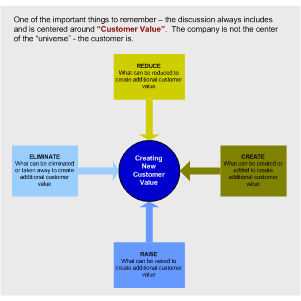
Don't compete where everyone else is, find new ways/methods/products/ services to make yourself different. Create new markets, products, customers. All makes since, but one of the keys is always keeping your customer in mind (which is tough for most big companies, there is always a belief that the customer will follow them - where ever they go). So, below is a graphic that depicts the creation of "Customer Value" - just in case the copyright cops come calling - I do not claim that I created this view - the authors of the book created this view [W. Chan Kim, Renée Mauborgne]

Click on the graphic below to see full size (and actually read the text)


Value of Information1

Checking up and Checking In

One secret of successful service providers is checking in (or up) on their customers. In some cases, it is to ensure they are happy with the service that everything is all right and nothing else needs to be done. In other cases, it is see if anything new required. In either case, it provides additional linkage between you and the customer.

A perfect example of checking up is the dentist my family uses – Dr. John Smith. After every procedure with any family member, he calls within 24 hours to make sure everything is all right and that there are not questions or problems. These calls don’t last long, but they leave a lasting impression – Dr. Smith cares about us. Does that mean we are bosom buddies or meet socially, no. We have a patient/doctor relationship. But anytime dentistry works its way into a conversation, I recommend Dr. Smith, mostly because he is a true service provider.

Not all services lend themselves to the check up/in, but for those that do, this is a powerful way to create a major difference between you and your competitors.

Customers purchase services, Clients buy relationships

OK, by now you’ve determined that I’m opinionated, I have a very distinct idea about success and business. But here’s the deal, you may read this blog hoping to find a couple of ideas, phrases or concepts you could use. But you’ll potentially buy my book (if I ever write one), or visit my web site, or ask me to consult with your company or speak at your meeting because I have established the foundations of a relationship with you.

Every company has “faceless” customers that purchase from them. Not everyone wants to be involved in every company they purchase from. By the mere fact that you don’t try to become “personal”, you are giving them what they want, anonymity. But be careful, customers are shy and most receive such bad service in the past, it’s easier to buy and go.

As a service provider, it is your job to find out the type relationship your customers want to have with you. Determine how “personal” they want to be, but be honest in developing this relationship. Be prepared to run the gamut with individual customers. Be aware of their “moods” and abide by them. Sometimes all we want to do is buy and go, other times it would be nice to chat and build a relationship.


The customer is not always right

I know, so far I’ve rattled on about how your customers rule the kingdom and you are the dutiful servant. Well sometimes “the emperor has no clothes”.

Its already been discussed that each of your customers are selfish and in that state, they are also self serving. Meaning, they may not want you to go out of business, but that doesn’t mean they won’t bend the rules to their favor.

The rule here is deal fairly with your customers, but don’t allow them to run all over you. If you provide additional service to your customer, make sure they know about it. Provide a Zero Dollar invoice detailing the work. If you have at strict policy (of any kind), stick to it. If one of your customers doesn’t like the work you performed, or you missed some expectation, try to make it right. There is not need to get angry or upset. If there’s a difference of opinion, deal with it quickly and efficiently. But with some customers, you could go the extra mile and they’d ask for two.

Whatever the cause, attempt to make the best of the situation, you may not end up with a great working relationship, but you may walk away with mutual respect.

Do the best you can do; meet your expectations and you’ll satisfy the majority of your customers.

Walk away from bad business

It’s not always possible to determine who is going to be a trouble customer, but once you realize you are in a lose/lose situation be honest enough to walk away.

During my time at one company, there was a saying about this type of situation “the large sucking sound”. It was used to refer to a client account that wasn’t going right (to either the expectations of the company's management or the client). It meant that the client was making noise and “sucking” up additional resources, making the account spend more money than the client was being billed. In some extreme cases, this was necessary to turn a bad situation around and truly create a win/win for everyone. In others, nothing could turn the account and eventually attorneys were involved (which is never a good situation).

We knew, and I assume senior management knew, which accounts were destined for legal action, but no one stood up to stop the situation. I’m telling you now, if you feel you are in a bad situation, it probably is a bad situation. Don’t let ego get in the way of a good business decision. It’s better to recognize it early and deal with it, than to waste time, money and resources to save a sinking ship.

You can’t please everyone

Just as in our personal lives, your business can not please everyone. The total population is not your potential market. If it is, I congratulate you on your success (or your mastery of government regulations). But if you find yourself in the situation, you have a bigger challenge than any company and that’s competing against yourself and keeping yourself motivated. But for the majority of us, that’s not the case.

To the original thought, You won’t be able to please every customer. You can excel in your industry and be lauded by the majority of your customers, but there will always be someone that doesn’t like you or your service. I say great. That means two things: 1) You are creating a service that meets the needs of a particular market and 2) there’s room for improvement.

Be Consistent – Customers don’t like surprises

McDonald’s (and more specifically Ray Kroc) built the fast food service industry on one major principle – consistency. Go into any McDonalds anywhere in the world and order a Quarter Pounder with Cheese and fries – and it will taste almost the same. In fact, the experience is the same (with small nuisances) from location to location. Love ‘em or hate ‘em, you’ll never be surprised.

There’s a story about the McDonalds French fry. It goes something like this…

During the early days of franchises, each location had some latitude concerning menu items, but there were two things that had to be the same, the famous “little” hamburger and the fries. As franchises spread across the country, the fries didn’t come out right at each location, Ray Kroc wanted the crispy, golden brown fry, not over cooked or undercooked. All the restaurants used the same potato, the same oil, but some locations just couldn’t get it right. After lots of trial and error, McDonalds found out it was a certain combination of the right ingredients, cooking temperature, cooking time and something very important (but overlooked), humidity. Once it was discovered, McDonalds not only wrote a detailed process document, they also had special fryers created. Consistency was that important.

One special note here , I don’t believe anyone should provide poor service, but it is better to provide bad service consistently, then great service sporadically. At least with consistent bad service, your customers have the proper expectation going into the transaction and can make decisions appropriately.

A personal note on bad service. During my 20’s, I lived in Denver and frequented a local neighborhood restaurant/bar. It was a great place to go and have a beer and some Mexican food and usually had a line for dinner. One of the things my friends and I enjoyed was going in on Sunday mornings and getting breakfast. They opened around 10am (I say around, because you never really knew if it would be 9am or 11am). As good as the service was at night (consistently rated top neighborhood bar in Denver), Sunday morning was the complete opposite. Sometimes they’d be open, sometimes not. Sometimes you get waited on, other times it would take forever just to get coffee. But the best time (we still a laugh about it) was the time we went in, sat down, order and served coffee, ordered our breakfast and waited. About 30 minutes later the waitress came by to tell us that they ran out of eggs and the cook went to go get some, but hadn’t returned.

They point is, we knew the service was going to be bad on Sunday mornings, but we loved going there. Just to see what would happen next. It was bad, but it was consistent.

Customers are Selfish

My wife will tell you that I am cheap (I prefer thrifty). I hate to throw money out the window. Case in point, I get my haircut at the cheapest barber shop in town and the only reason I go there is because they don’t expect a tip. BUT, I don’t want to look like I got the cheapest haircut in town.

This illustrates the point – customers are selfish. They want to receive a better service then they are willing to pay for. I only want to pay $8.00 for a haircut, but I want it to look like a $50.00 haircut. That may be unrealistic; nonetheless, that’s what I want. There’s an old saying “a $100 shine on a $5.00 pair of shoes”. ; That’s what your customers are looking for when they pay money for your service. And it’s not necessarily about getting something cheap. In the haircut example, even if I chose to pay more money for my haircut, I would expect it to look more expensive than it really was.

It is a fact of life your customers will demand more perceived value than they are willing to pay for. So if you are a lawyer and charge $200 per hour, your clients won’t be satisfied unless they perceive the end result to be work at least $250 or $300 per hour. Your customers expect more value out of your service. It’s not a matter economics, it’s that your customers are selfish. They want that $100 shine or the $50 haircut. If you can provide that kind of exceptional value, you’ll create customers for life.

One other interesting phenomenon about the selfish customer, they want to know they made the right decision. They will look to re-enforce that decision in any way possible. One of the reasons we recommend companies to our family and friends is to re-enforce our purchasing decisions. Clients and customers that refer people to you may be the most selfish people you deal with. They want other people to see what they see, they want a third party to validate their purchasing decision. At the end of the day, customers are selfish and the more selfish the better for all of us.